
| A brief introduction
to the Brazilian Semiarid Tropics and the twin cities of PETROLINA and JUAZEIRO and their
surroundings
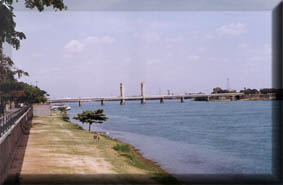
The cities of Petrolina and Juazeiro are located in the heart of Brazil's semiarid tropics on the opposite banks of the river São Francisco. The river is the dividing line between these two cities as well as between the states of Pernambuco and Bahia. Petrolina and Juazeiro are the leading commercial and cultural centers in an increasingly important economic area. Combined they have about 400,000 inhabitants and offer most of the conveniences and services of large cities. The São Francisco River (2,700 km) is one of Brazil's largest rivers crossing five states on its way to the Atlantic. It was named after Saint Francis by the Europeans who saw it for the first time in 1501 and later nicknamed Velho Chico (Old Frankie). Over the centuries it has become one of the focal points of Brazilian folklore with countless stories and songs dedicated to it. Despite some of the destruction along the river--mostly caused by dam building and deforestation--the river continues to be a lifeline for the millions of people living on its banks. Up- and down-river from the twin cities, the São Francisco has sandy beaches, clear water and countless islands, providing a perfect environment for ecological tourism. The São Francisco is also known for its rich fishing opportunities. These fish are often prepared with coconut milk, one of the main ingredients in Northeastern Brazilian cooking. Another local staple is manioc (or cassava). Besides being cooked or used in cakes it is also ground into flour (farinha) and as such used to go along with a typical Brazilian plate of rice, beans and meat. Another very popular food item throughout the Northeast is rapadura (a block of raw brown sugar). Brazil's Northeast has been the source for much of the country's inspirational historic events and popular culture. The famous peasant republic of Canudos, destroyed by the Federal Army hundred years ago, is just a couple hundred kilometers east of the cities. In the twenties and thirties Brazil's most legendary outlaws--Lampião and Maria Bonita--evaded police for nearly ten years hiding out in the semiarid Northeast. Some of Brazil's best known novels describe the region and the people of the Northeast. Many popular singers from the past as well as from the present were born and raised in this area. Among the most famous composers and singers from the past Luiz Gonzaga. Nowadays, the popular singers João Gilberto and Ivete Sangalo are natives of Juazeiro. Petrolina and Juazeiro have a tropical semiarid climate. The rainy season lasts from December to March. During the last 10 years, Petrolina and Juazeiro had an average temperature of 24,5 C in July, with occasional drizzles and high indications of evaporation. The distance between Petrolina and Juazeiro and São Paulo or Rio de Janeiro is about 2,250 km, to the capital Brasilia it is about 1,550 km. The distance between Petrolina and Recife, the capital of Pernambuco, is 721 km; the distance between Juazeiro and Salvador, the capital of Bahia, is 513 km. |

 If
a foreigner thinks of Brazil the first things that come to mind are probably the carnival
in Rio de Janeiro, Brazilian soccer players and the destruction of but also the
initiatives to save the tropical rain forests. All these phenomena are only glimpses of
the reality of a country the extension of the world's fifth largest country (8.511.996
million square kilometers) with 160 million inhabitants. About 12 % of Brazil's surface
are located in a tropical semiarid climate zone. This semiarid zone is situated in the
Northeast of the country and referred to as caatinga. About 17 million people
live in the caatinga which covers nearly one million square kilometers. Annual
rainfall is below 1000 mm with less than 500 mm in the central part of the semiarid region
and very irregularly distributed space and time wise. For the past two decades the
government and multinationals have installed huge irrigation projects on the São
Francisco River, employing local people as day laborers.
If
a foreigner thinks of Brazil the first things that come to mind are probably the carnival
in Rio de Janeiro, Brazilian soccer players and the destruction of but also the
initiatives to save the tropical rain forests. All these phenomena are only glimpses of
the reality of a country the extension of the world's fifth largest country (8.511.996
million square kilometers) with 160 million inhabitants. About 12 % of Brazil's surface
are located in a tropical semiarid climate zone. This semiarid zone is situated in the
Northeast of the country and referred to as caatinga. About 17 million people
live in the caatinga which covers nearly one million square kilometers. Annual
rainfall is below 1000 mm with less than 500 mm in the central part of the semiarid region
and very irregularly distributed space and time wise. For the past two decades the
government and multinationals have installed huge irrigation projects on the São
Francisco River, employing local people as day laborers.